'I am loathe to believe that we will attach greater value to the sight of Lowburn Bay stocked to capacity with a few water skiers on the incoming weekend tide than we will to the enjoyment of hundreds at picnics on the shade-dappled grassy banks of the rolling Clutha at Bendigo, which must be one of the most beautiful stretches of flowing water in the world.' - K.F. O'Connor, Multiple Resource Use in the Upper Clutha Valley, Journal of Hydrology (NZ) Vol 14, No. 2, 1975.

Lowburn History

In the early settlement days of Central Otago, Lowburn was a prominent ferry landing for travellers moving between the goldmining reefs of Bendigo and the township of Cromwell.

There had been a Welcome Home Hotel in the area since 1865, when the first hotel was built by John and Charlotte Perriam on the Quartz Reef side of the river. In 1869, they completed a new stone hotel across the river in the growing settlement of Lowburn Ferry. Mrs Perriam became the proprietress in 1883 after the death of her husband. The stone hotel had thirteen bedrooms, three sitting-rooms, a bar, kitchen, and a dining-room that could seat twenty guests. There was a stable at the back and an adjoining store stocking general merchandise.


Welcome Home Hotel


The hotel was located on the main street facing the Clutha River. It was rebuilt and renovated a number of times, but retained many of its historic features and artifacts. The hotel was the headquarters of the Lowburn Curling Club and always had a colourful place in the community.

A ferry or punt began operating on the Clutha River at Lowburn from about 1873, and the crossing, with its tree-lined approaches and picturesque setting became not only an important link between Cromwell and the lakes at Wanaka and Queenstown, but also a popular tourist excursion.


Lowburn Ferry, circa 1920, by JH IngleyLowburn Ferry, circa 1920, by JH Ingley

Welcome Home Hotel

Welcome Home Hotel, circa 1880


There had been a Welcome Home Hotel in the area since 1865, when the first hotel was built by John and Charlotte Perriam on the Quartz Reef side of the river. In 1869, they completed a new stone hotel across the river in the growing settlement of Lowburn Ferry. Mrs Perriam became the proprietress in 1883 after the death of her husband. The stone hotel had thirteen bedrooms, three sitting-rooms, a bar, kitchen, and a dining-room that could seat twenty guests. There was a stable at the back and an adjoining store stocking general merchandise.

The building was located on the main street facing the Clutha River, where the Lowburn Ferry operated for 63 years until 1938, when a concrete arch bridge was built across the river. The hotel was rebuilt and renovated a number of times, but retained many of its historic features and artefacts. The hotel was the headquarters of the Lowburn Curling Club and always had a colourful place in the community.


Welcome Home Hotel, circa 1978


Welcome Home Hotel, 1984


1984 Sign

Lowburn Ferry

Lowburn Ferry, circa 1920


Lowburn Ferry, circa 1920, by JH IngleyLowburn Ferry, circa 1920, by JH Ingley

Sold Down The Reservoir

Welcome Home Hotel, 1978, with the first of two signs that would appear on the pub.
Photograph by Robin Morrison


The second sign, of a man having a beer through a snorkel, was put up in the 1980's ~
'In 198? this hospitable place could be 20 metres beneath the new Lake Dunstan.'


Signs placed on Lowburn's Welcome Home Hotel in the 1970s and 1980s voiced the stoic despair of a community facing inundation if, and when, the Clyde dam reservoir would be pronounced safe enough to fill.

In the lead up to the New Zealand elections in 1975, one aspiring candidate was Warren Cooper. There had been uncertainty over hydro dam plans on the Clutha for many years. Questioned at the Lowburn pub by Shorty Sutherland, a retired gold-miner who lived across the road, Mr Cooper promised not to flood Lowburn and the pub. Mr Cooper said: "If you want water in your whiskey, vote Labour."

In 1977, Warren Cooper MP, strode onto the recently constructed Clyde dam lookout, beyond which work had begun on the dam that would eventually flood the Cromwell Gorge, part of Cromwell and much of the Lowburn area including five orchards and the Lowburn pub, where he had made his earlier promise. He had come to address a protest group called "Clutha Rescue," who had set up camp at the lookout. Mr Cooper asked: "Why can't you support me over the construction of this dam?"

The building of the dam was opposed by five landowners at Lowburn and two in the Cromwell Gorge. They took their case against the Government to the High Court in Wellington, who ruled in their favour, determining that there was no end user for the power at Clyde and that the applicant had no water right.

But Prime Minister Robert Muldoon rallied his supporters. In the end legislation was passed with the help of the two Social Credit MP's. The Clutha Development (Clyde Dam) Empowering Act was enacted on the 30th of September 1982. All legal avenues for legitimate objection had been removed.

The Lowburn community had been cast aside, sold down the reservoir, lock stock and beer barrel. Outside the pub, a sign appeared showing a man having a drink wearing a snorkel. In 1988, the bulldozers arrived to demolish the hotel and 'reshape' the valley. The Welcome Home Hotel, the Motor Camp, the houses along the main street, the concrete arch bridge across the Clutha, the "hundred islands" with numerous popular campsites and swimming-holes, and some of the best farmland in the region, all disappeared into the pages of a bitter history.


Lowburn Valley after the Clyde damLowburn and the Clutha Valley after the Clyde dam


'In all the history of Otago and of New Zealand, in peace and in war, the Clutha proposals must rank as the cruellist and most premeditated. Conceived in departmental ambition, nourished in secrecy and permitted by political indifference for people, the Clutha proposals hardened into unpalatable fact.' ~ Paul Powell, 'Who Killed the Clutha?'

The Lowburn Bridge

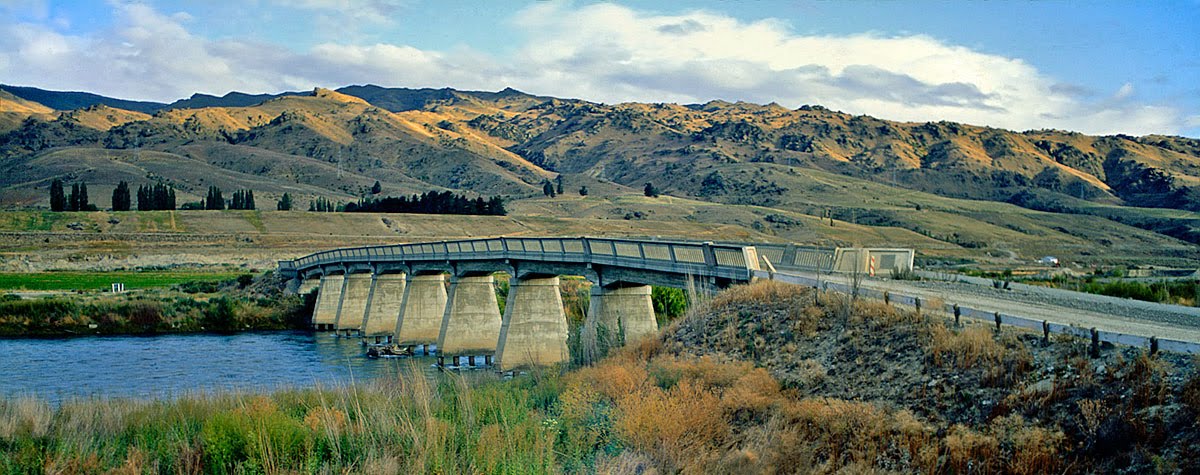
Opened in 1938 to replace the heavily used ferry, the Lowburn Bridge was constructed of concrete spans, forming a single-lane structure with an unusual arch. The approaches to the bridge on both sides were ramped with the possible intention of allowing floodwaters to pass around the bridge. The bridge was sited exactly where the ferry had been, with an avenue of trees on the western side leading directly to the nearby Welcome Home Hotel, at a 'T' intersection at the centre of Lowburn. Permanent homes and holiday houses were interspersed among the trees.


Lowburn Bridge, February 1992, after the trees and buildings were cleared


Prior to the filling of the Dunstan reservoir - in three stages between 1992-93, the Lowburn area was entirely cleared of trees and buildings, but the bridge was left. Before the waters rose a car was parked on the centre span of the bridge, and it still rests there today, submerged in the murky gloom, as a ghostly point of interest for divers.

About This Site

A brief history of Lowburn before the Clyde dam inundated the turquoise river, flooding our campsites, farms, and orchards. Where now, can we go to sit in the dappled shade beside the swift crystal waters, cooled by the moving air and the song of the river? Where is our river paradise? It is 60ft under.

  © Free Blogger Templates 'Photoblog II' by Ourblogtemplates.com 2008

Back to TOP