'I am loathe to believe that we will attach greater value to the sight of Lowburn Bay stocked to capacity with a few water skiers on the incoming weekend tide than we will to the enjoyment of hundreds at picnics on the shade-dappled grassy banks of the rolling Clutha at Bendigo, which must be one of the most beautiful stretches of flowing water in the world.' - K.F. O'Connor, Multiple Resource Use in the Upper Clutha Valley, Journal of Hydrology (NZ) Vol 14, No. 2, 1975.

Lowburn History

In the early settlement days of Central Otago, Lowburn was a prominent ferry landing for travellers moving between the goldmining reefs of Bendigo and the township of Cromwell.

There had been a Welcome Home Hotel in the area since 1865, when the first hotel was built by John and Charlotte Perriam on the Quartz Reef side of the river. In 1869, they completed a new stone hotel across the river in the growing settlement of Lowburn Ferry. Mrs Perriam became the proprietress in 1883 after the death of her husband. The stone hotel had thirteen bedrooms, three sitting-rooms, a bar, kitchen, and a dining-room that could seat twenty guests. There was a stable at the back and an adjoining store stocking general merchandise.


Welcome Home Hotel


The hotel was located on the main street facing the Clutha River. It was rebuilt and renovated a number of times, but retained many of its historic features and artifacts. The hotel was the headquarters of the Lowburn Curling Club and always had a colourful place in the community.

A ferry or punt began operating on the Clutha River at Lowburn from about 1873, and the crossing, with its tree-lined approaches and picturesque setting became not only an important link between Cromwell and the lakes at Wanaka and Queenstown, but also a popular tourist excursion.


Lowburn Ferry, circa 1920, by JH IngleyLowburn Ferry, circa 1920, by JH Ingley
Lowburn Ferry

Lowburn Ferry, circa 1920


Lowburn Ferry, circa 1920, by JH IngleyLowburn Ferry, circa 1920, by JH Ingley

The Lowburn Bridge

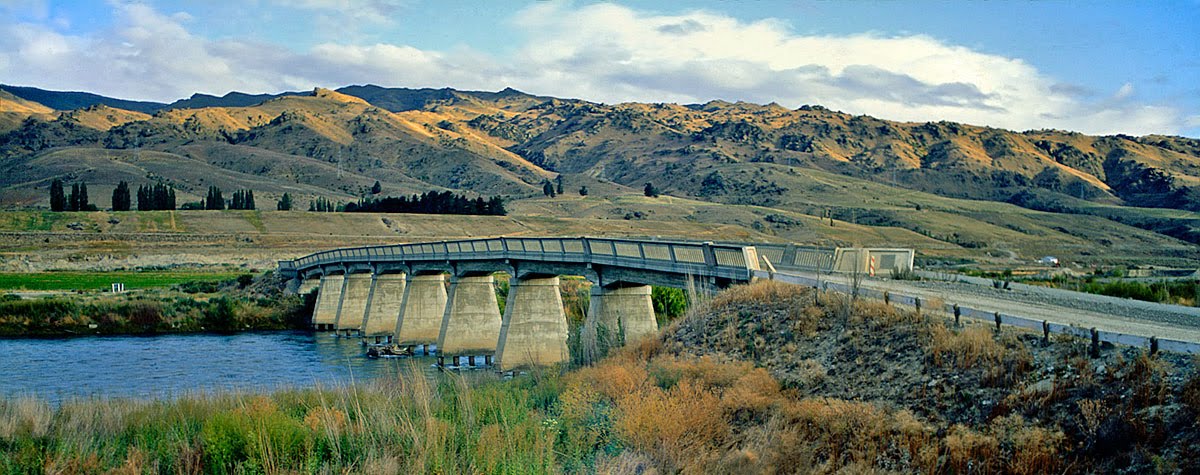
Opened in 1938 to replace the heavily used ferry, the Lowburn Bridge was constructed of concrete spans, forming a single-lane structure with an unusual arch. The approaches to the bridge on both sides were ramped with the possible intention of allowing floodwaters to pass around the bridge. The bridge was sited exactly where the ferry had been, with an avenue of trees on the western side leading directly to the nearby Welcome Home Hotel, at a 'T' intersection at the centre of Lowburn. Permanent homes and holiday houses were interspersed among the trees.


Lowburn Bridge, February 1992, after the trees and buildings were cleared


Prior to the filling of the Dunstan reservoir - in three stages between 1992-93, the Lowburn area was entirely cleared of trees and buildings, but the bridge was left. Before the waters rose a car was parked on the centre span of the bridge, and it still rests there today, submerged in the murky gloom, as a ghostly point of interest for divers.

About This Site

A brief history of Lowburn before the Clyde dam inundated the turquoise river, flooding our campsites, farms, and orchards. Where now, can we go to sit in the dappled shade beside the swift crystal waters, cooled by the moving air and the song of the river? Where is our river paradise? It is 60ft under.

  © Free Blogger Templates 'Photoblog II' by Ourblogtemplates.com 2008

Back to TOP